William J. Jackson
Partner
Kelley Drye is on the vanguard of legal issues related to per- and polyfluoroalkyl substances (PFAS). We have the preeminent team of attorneys dedicated to helping clients address PFAS contamination.

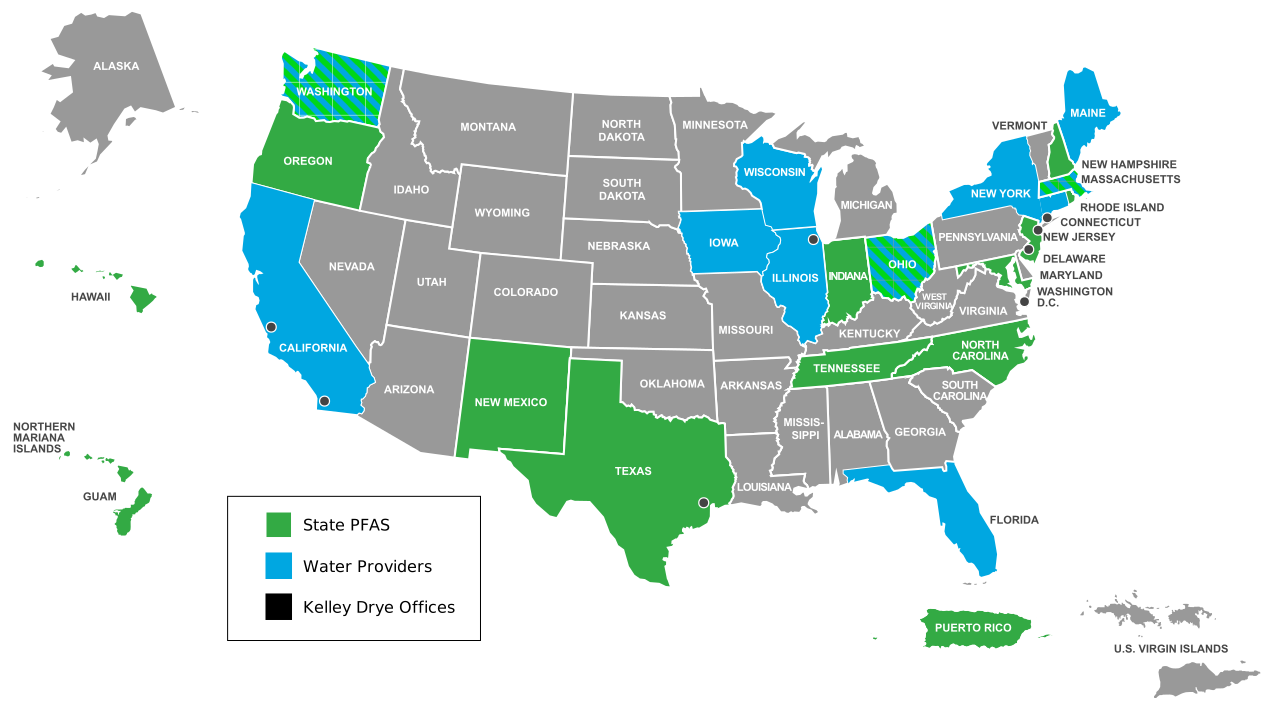
Kelley Drye represents 15 states and sovereign governments and dozens of water providers in PFAS litigations across the country. Kelley Drye was lead counsel for the State of New Jersey in its month-long trial against DuPont for PFAS and other contamination in New Jersey, resulting in settlements with 3M and DuPont that cumulatively recovered $2.5 billion in remediation, restoration, damages and costs for New Jersey.
WHAT ARE PFAS | THE EFFECTS OF PFAS | PFAS REGULATION
Kelley Drye is lead-counsel in the largest and most significant PFAS litigations in the country, both for public and private clients.
Kelley Drye represents numerous states, municipalities, and water districts, as well as private sector clients, in more than twenty state and federal litigations throughout the country involving environmental contamination by PFAS. Most recently, our team served as Lead Counsel for the State of New Jersey in the first state case against a PFAS manufacturer for remediation costs and natural resource damages resulting from PFAS. Before trial commenced, the team secured a landmark settlement for New Jersey with 3M, resulting in a cash settlement that will bring up to $450 million in recoveries to New Jersey for PFAS abatement projects, natural resource restoration, water treatment, and other actions to address the impacts of PFAS across the State. Then, following a month long trial against DuPont and related companies before Chief Judge Renee Bumb of the District of New Jersey, the Kelley Drye team negotiated a settlement with DuPont and related companies bringing another $2 billion in remediation, restoration and damages to the people of New Jersey.
Putting these results together with the 2024 and 2025 settlements with Solvay and Arkema for PFAS from their operations in West Deptford, the Kelley Drye team has recovered $3 Billion in remediation, restoration, PFAS abatement, and Natural Resource Damages for New Jersey since 2019.
Our team also represents numerous states and public water providers in claims related to the use of firefighting foam – aqueous film-forming foam (AFFF) – and other products that contain PFAS compounds. Thousands of cases from across the nation involving AFFF claims, including cases brought by Kelley Drye’s clients, have been consolidated in a multi-district litigation in the U.S. District Court for the District of South Carolina (AFFF MDL), where Kelley Drye attorneys have been appointed to numerous positions on the Plaintiffs’ Executive Committee that leads the AFFF MDL, including serving on the Plaintiffs Executive Committee, chairing the States/Sovereigns Committee, co-chairing the Property Damage Committee, and serving on the Discovery Committee.
Kelley Drye attorneys bring decades of unmatched experience in complex environmental contamination and natural resource damages matters, including on behalf of states and private businesses, and are applying that experience to PFAS regulation and litigation. In addition to litigation services, Kelley Drye counsels clients with internal investigations into PFAS risks and liability, how to mitigate those risks, and represents them in actions to recover costs they incur to address PFAS contamination.
Innocent customers and unwitting users of PFAS-containing products are already liable for PFAS investigation and remediation costs – including significant drinking water treatment costs – as “responsible parties” under several state environmental laws. In 2025, the federal government also designated two PFAS chemicals, PFOA and PFOS, as “hazardous substances” under the Comprehensive Environmental Response, Compensation, and Liability Act (CERCLA). As a result, companies that used PFAS – whether knowingly or not and without consideration of fault – may be strictly liable under CERCLA for cleanup costs at their own facilities and offsite disposal sites, as well as resulting injuries to natural resources and the costs to assess them. Our team is ready to assist businesses in connection with these potential liabilities arising under CERCLA and similar state laws, combining its years of experience in such matters with its unparalleled background in PFAS litigation and regulation.
In short, Kelley Drye is uniquely positioned to provide cutting-edge, yet cost-effective, legal services related to PFAS, through decades of experience and the most up-to-date knowledge of the shifting PFAS landscape.
PFAS belong to a class of man-made chemicals known as perfluorinated compounds. There are thousands of PFAS chemicals in use and in the environment today. These chemicals include perfluorooctane sulfonate (PFOS), perfluorooctanoic acid (PFOA), perfluorodecanoic acid (PFDA), perfluorononanoic acid (PFNA), perfluorobutanesulfonic acid (PFBS), perfluorohexanoic acid (PFHxA), perfluorohexanesulfonate (PFHxS), and HFPO dimer acid (GenX).
PFAS were originally developed in the 1940s, and put into large-scale manufacture and use by the early 1950s. These compounds have unique physical and chemical properties – including their carbon-fluorine bond – which can impart oil, water, stain, and soil repellency, chemical and temperature resistance, friction reduction, and surfactant properties to a wide range of products. The unique ability of PFAS to repel both oil and water has led to their application in numerous household goods and apparel.
PFOA and PFOS have been the most extensively produced and studied of these chemicals. They are persistent, bioaccumulative, and linked to various human diseases and cancers. While U.S. manufacturers have phased out their domestic use of PFOA and PFOS and other long-chain PFAS chemicals, they have shifted production to shorter-chain PFAS chemicals mentioned above.
Because of their unique properties, including waterproof, stain-resistant, and non-stick, PFAS are ubiquitous in industrial and consumer products and, now, in the natural environment:
Risks to Human Health and the Environment
Because of their wide use, PFAS effect everyone. PFAS are found in the blood of virtually all humans and animals throughout the world, including newborn babies.
The EPA has identified PFOS and PFOA as emerging contaminants and has listed PFOA as a likely carcinogen finding that no level of PFOA in drinking water is safe.
Research is ongoing, but current evidence suggests that PFOS and PFOA pose a significant risk to human health and the environment. Approximately 95% of people tested have PFAS in their blood, and PFAS can be detected in human breast milk and umbilical cord blood. Exposure to PFAS over certain levels may result in adverse health effects, including developmental effects, and independent epidemiological studies link numerous adverse health conditions to high exposures of PFOS or PFOA, including kidney cancer, testicular cancer, ulcerative colitis, thyroid disease, pregnancy-induced hypertension, high cholesterol, liver damage, decreased fertility, and decreased antibody response to vaccines. Laboratory animals exposed to PFOS and PFOA have displayed changes in liver, thyroid, and pancreatic function, as well as developmental, immunological, and cancer effects.
Personal injury and related litigation regarding exposure to PFOA in particular has been ongoing since 1999. States and other public entities have increasingly brought litigation under their authority to protect the well-being of their citizens and their natural resources.
Risks to Businesses
Private businesses are also impacted directly and/or indirectly by these chemicals, either from their use during industrial production or from the use of products that contain these chemicals, such as AFFF. Potentially impacted industries include:
Federal Action Regarding PFAS
PFAS are an increasingly significant focus of federal and state regulation. In this dynamic regulatory environment, it is crucial to seek ongoing advice from expert legal counsel.
The novelty of addressing emerging contaminants like PFAS engenders a complex regulatory landscape across multiple jurisdictions. At the federal level, the EPA has taken steps to regulate PFAS under federal environmental laws, such as the Comprehensive Environmental Response, Compensation, and Liability Act (CERCLA), the Resource Conservation and Recovery Act (RCRA), the Safe Drinking Water Act (SDWA), the Emergency Planning and Community Right-to-Know Act (EPCRA), and the Toxic Substances Control Act (TSCA).
Simultaneously, states and territories have played leading roles in regulating PFAS. California, New Jersey, Minnesota, Vermont, and others have adopted drinking water or cleanup levels more stringent than federal guidance and that frequently cover a broader range of compounds. Several states and territories have also taken legal action to address PFAS and aqueous film-forming foam (AFFF) contamination, including New Jersey, Michigan, Minnesota, New York, North Carolina, and Guam. Further, 37 states and territories have cases in the multi-district litigation, In re Aqueous Film-Forming Foam Products Liability Litigation, MDL No. 2873, pending in the U.S. District Court for the District of South Carolina.
Overall, the regulatory landscape for PFAS continues to evolve. Challenges to federal regulations, compounded by the deregulatory attitude of the Trump Administration’s EPA, may prompt states to intensify their regulatory efforts. As new PFAS requirements emerge, impacted parties must stay abreast of the evolving regulatory landscape and any related litigation.
Kelley Drye is closely monitoring all federal and state PFAS regulatory developments and represents numerous states, water providers, and private sector clients in litigation and enforcement matters. For questions, please contact our team.
Partner


Partner


Partner


Partner


Partner


Partner


Partner


Partner


Partner


Partner


Partner

Partner

Partner

Partner

Of Counsel

Special Counsel

Special Counsel

Special Counsel

Special Counsel

Special Counsel

Special Counsel

Senior Associate

Senior Associate

Senior Associate

Senior Associate

Associate

Associate

Associate

Associate

Associate

Discovery Attorney